ServicesWell Water Filtration
Well Water Filtration and Treatment in Round Rock
A private well sends untreated water straight into your home. We test it, then recommend and install the right new filter system for what is in your water: sediment, iron, sulfur smell, hardness or bacteria.
What well water filtration actually involves
Municipal water is disinfected and monitored before it reaches you. A private well gets none of that. The water leaving your pressure tank reflects the rock the well taps into, and its makeup can shift after a dry summer, a stretch of heavy rain or a change to the pump. In the limestone under much of the Round Rock area, wells commonly pick up hardness, and some add iron or a hydrogen sulfide odor on top of it.
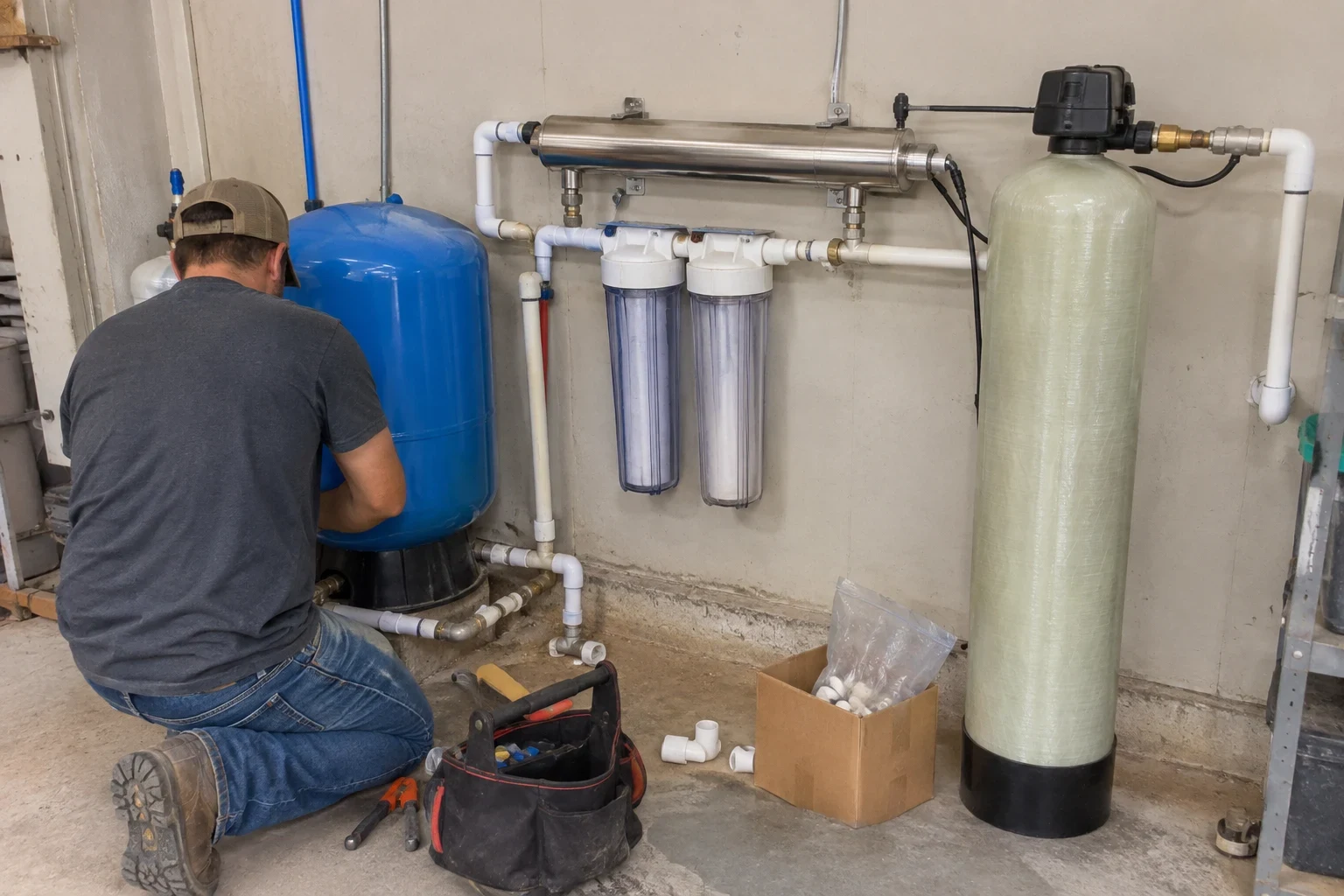
One filter cannot cover all of those problems. A working setup is a chain of stages placed in a deliberate sequence. Grit and sand get captured at the front so they cannot plug the media further down the line. The iron and sulfur stage follows, oxidizing those minerals and holding them for backwash. Hardness treatment comes next. The UV chamber sits at the very end, since a lamp cannot disinfect water that is still murky or tinted.
Every well system we put in starts with a test of your well water. Hardness, iron, manganese, pH and sulfur readings, along with your well's flow rate and how many bathrooms draw water at once, set the stages we choose and the size of each tank. If an old unit is in place, we take it out and install the new system in its spot.
What we install
Test review and stage plan
We read your water test result by result and explain which number calls for which stage. If a reading is borderline, we say so instead of adding equipment you may not need.
Sediment prefiltration
A spin-down screen or a pleated cartridge housing catches sand and grit at the pressure tank. It protects every valve and media bed downstream from wear.
Iron, manganese and sulfur stage
Air-injection or catalytic media filters oxidize dissolved iron and hydrogen sulfide so they can be filtered out and backwashed to drain. Our Iron and Sulfur Removal page covers this stage in more depth.
Hardness control
Where the test shows enough hardness to scale fixtures, we add a softener or a salt-free conditioner after the iron stage, so iron does not foul the resin.
UV disinfection
A UV chamber with a quartz sleeve sits at the end of the train to inactivate bacteria in water that is already clear. See UV Water Purification for how the lamp and sleeve are sized.
Sized to Your Well
We size each new tank, the media inside it and the control valve to your test results and your well's flow rate. That way water moves through each stage slowly enough to be treated, and backwash timing matches your household's water use.
When your well water is telling you something
Rust marks on fixtures
Reddish-brown rings in the toilet bowl or tub come from dissolved iron that turns solid once it is exposed to air. The same iron leaves yellow and orange marks on white laundry.
Hot water that smells of sulfur
Hydrogen sulfide gas dissolved in the water gives off the odor, and it often shows up most when you run the hot side. A magnesium anode rod in the water heater can react with the gas and make the smell stronger.
Cartridges that choke early
A sediment cartridge that goes dark and cuts your flow after only a few weeks means the well is producing more solids than that housing was sized to handle.
Film inside the toilet tank
A slimy red or gray coating can be iron bacteria. These bacteria feed on the iron in the water and gradually foul filters, valves and fixtures.
Coliform on a lab report
Any coliform result means the water should be disinfected before anyone drinks it. The well itself also deserves an inspection to find how bacteria are getting in.
How a well filtration job runs
- 1
Free water test
We test for hardness, iron, manganese, pH and sulfur. You see the numbers, and you see what the water needs.
- 2
Written recommendation
You get a written recommendation that lists each stage and the reason for it.
- 3
Installation day
We shut the water off after the pressure tank, plumb in each stage with bypass valves, run a drain line for backwashing units and set up a dedicated outlet for UV if needed. Then we program backwash timing to match your household's water use and flush the system.
- 4
Retest and walkthrough
After the media settles, we retest the water to confirm each stage is doing its job. We show you the bypass valves and when cartridges, salt or the UV lamp are due.
What moves the price
Well systems vary more than city-water systems, so the price follows what your test finds and what is already in place. We offer free installation, and your quote lists each part separately so you can see where the money goes.
- Number of stages
- A well that only needs sediment filtration and UV costs far less than one that also needs iron removal and hardness control.
- Flow rate and demand
- Tank and media size follow your well's flow rate and how many bathrooms draw water at once. Undersized media lets iron and sulfur slip through.
- Condition of current equipment
- If an old unit is in place, we remove it and install the new system in its spot. Tank size, valve type and media set the equipment price.
- Space, drain and power
- Backwashing filters need a drain line and UV needs an outlet. Tight utility spaces or long runs add work.
- Ongoing parts
- UV lamps, quartz sleeves, cartridges and media all have service intervals. We include those in the conversation so the full cost of ownership is clear.
Questions about filtering well water
Something not covered here? (512) 812-9374
Which well filter system do I need?
That depends on what your test finds. Sediment calls for a prefilter, iron or a sulfur smell for an oxidizing stage, hardness for a softener or salt-free conditioner, and bacteria for UV at the end of the line. We size each new stage to your readings and your well's flow rate, and we explain why each one is there before anything is installed.
Will a water softener take care of iron too?
Only up to a point. Softener resin will exchange a little dissolved iron, but at higher concentrations the iron coats the resin beads and wears them out early. When your test shows a meaningful iron reading, we put a dedicated iron stage in front of the softener so the resin lasts.
Does a UV system clean the well itself?
No. The lamp disinfects water only as it flows through the chamber inside your home, so the protection starts at that point in the plumbing. If a test comes back positive for bacteria, we will recommend having the well head and casing inspected by a well contractor, because that work falls outside what we do.
How is this different from whole-home filtration on city water?
Treated city water mostly needs its chlorine taste and odor taken out, which the carbon systems on our Whole-Home Filtration page handle. A private well can deliver sediment, iron, sulfur and bacteria all at once, so it typically calls for several stages installed in a deliberate sequence.
How often are filter changes needed?
Swap sediment cartridges when they darken or your water pressure drops. Plan on a fresh UV lamp roughly every twelve months, and we wipe down the quartz sleeve while the old lamp is out. Backwashing media can run for years, but it is worth rechecking whenever a new water test shows different numbers.
Find out what your well is sending into your home
A free water test shows which stages you need and which new system fits. We walk you through the results by phone or in person.