ServicesReverse Osmosis Systems
Reverse Osmosis Systems in Round Rock
We install under-sink reverse osmosis systems for drinking and cooking water, and we replace an old or slow unit with a new one. Every job starts with a free water test, so the system we recommend fits your water and your sink cabinet.
What an RO System Does and When It Makes Sense
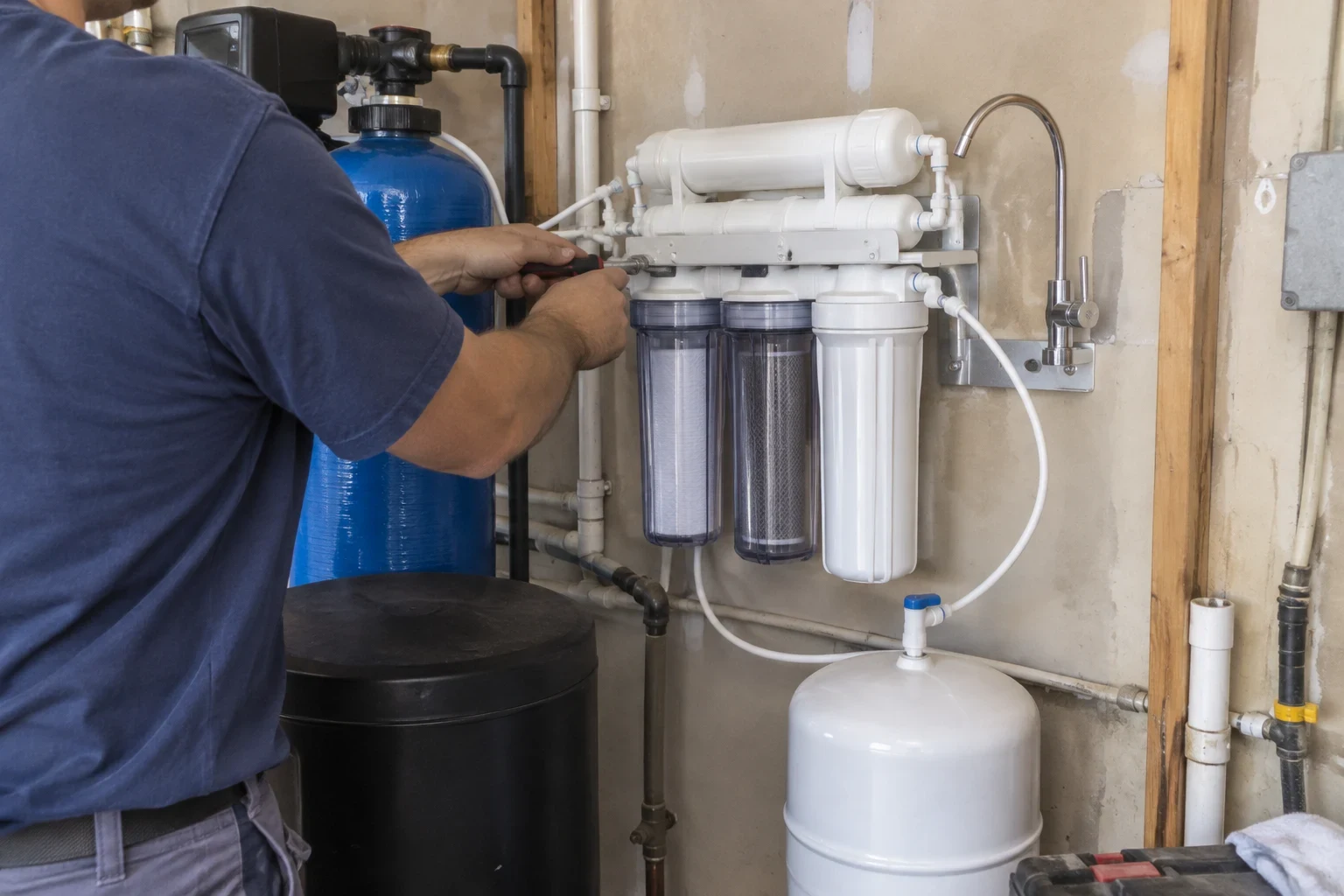
Reverse osmosis forces cold water against a semipermeable membrane. Water molecules pass through, while dissolved minerals, lead, nitrates and most other dissolved solids stay behind. Before the membrane, a sediment prefilter traps grit and a carbon block removes chlorine, which would otherwise wear down the membrane over time. The clean water fills a small pressure tank, passes a last carbon polishing filter and pours from a separate faucet at your sink.
RO is the right pick when you want very clean water at one faucet for drinking, coffee, cooking and ice, and treating every gallon in the house isn't the goal. Central Texas water is high in dissolved hardness, so RO water tastes clearly different here and the prefilters carry a heavy load. When the trouble is house-wide, like an odor in the shower or scale on fixtures, whole-home filtration or a water softener is the better tool.
We install two systems. The tankless RO makes 800 gallons per day through 7 stages, filtering down to 0.0001 micron, and leaves more room in the cabinet because there is no storage tank. The lower-price 5-stage tank RO runs water through sediment, GAC, carbon block, an RO membrane and post carbon, then holds it in a small pressure tank under the sink. Your test results and cabinet space decide which one fits.
What Our RO Work Covers
New under-sink installs
We install a tankless RO system (800 gallons per day, 7 stages, 0.0001 micron) and a lower-price 5-stage tank RO (sediment, GAC, carbon block, RO membrane and post carbon), sized to your test results and your sink cabinet. That includes the cold water feed valve, drain saddle, pressure tank and a dedicated faucet. We offer free installation.
Tankless RO
A tankless system rated at 800 gallons per day sends water through 7 stages down to 0.0001 micron. With no storage tank, it delivers filtered water on demand and frees up space in the sink cabinet.
5-stage tank RO
Our lower-price option runs water through sediment, GAC and carbon block filters, an RO membrane and a post carbon filter. Filtered water waits in a small pressure tank so it is ready at the faucet.
Leaks and valve faults
Dripping push-fit connectors, a cracked housing, a stuck automatic shutoff valve or a failed check valve. These are small, inexpensive parts, and swapping them usually saves the system.
Refrigerator and ice maker hookups
We can tee the RO output into a supply line for your refrigerator. That way the dispenser and the ice maker pour the same filtered water you get at the sink.
Signs Your RO System Needs Attention
- Slow flow at the faucet
- Clogged prefilters or a tank that has lost its air charge are the usual causes. Both are fixable.
- The old taste is back
- A worn membrane lets more dissolved solids through. A TDS meter reading tells us in seconds whether the membrane or just the carbon is spent.
- Water runs to the drain nonstop
- If water keeps trickling into the drain line for hours after the tank has filled, a failed shutoff or check valve is the likely cause. That sends good water down the drain all day and all night.
- Gurgling or spitting from the faucet
- An air-gap faucet that sputters or drips onto the counter often has a partially blocked drain line or saddle.
- Moisture in the sink cabinet
- Even a slow drip from a fitting can swell particleboard. Check the base of the housings and the tank connection.
- Filters you can't remember changing
- If it has been more than a year, the carbon stage may no longer be protecting the membrane.
How an RO Visit Works
- 1
Test the water
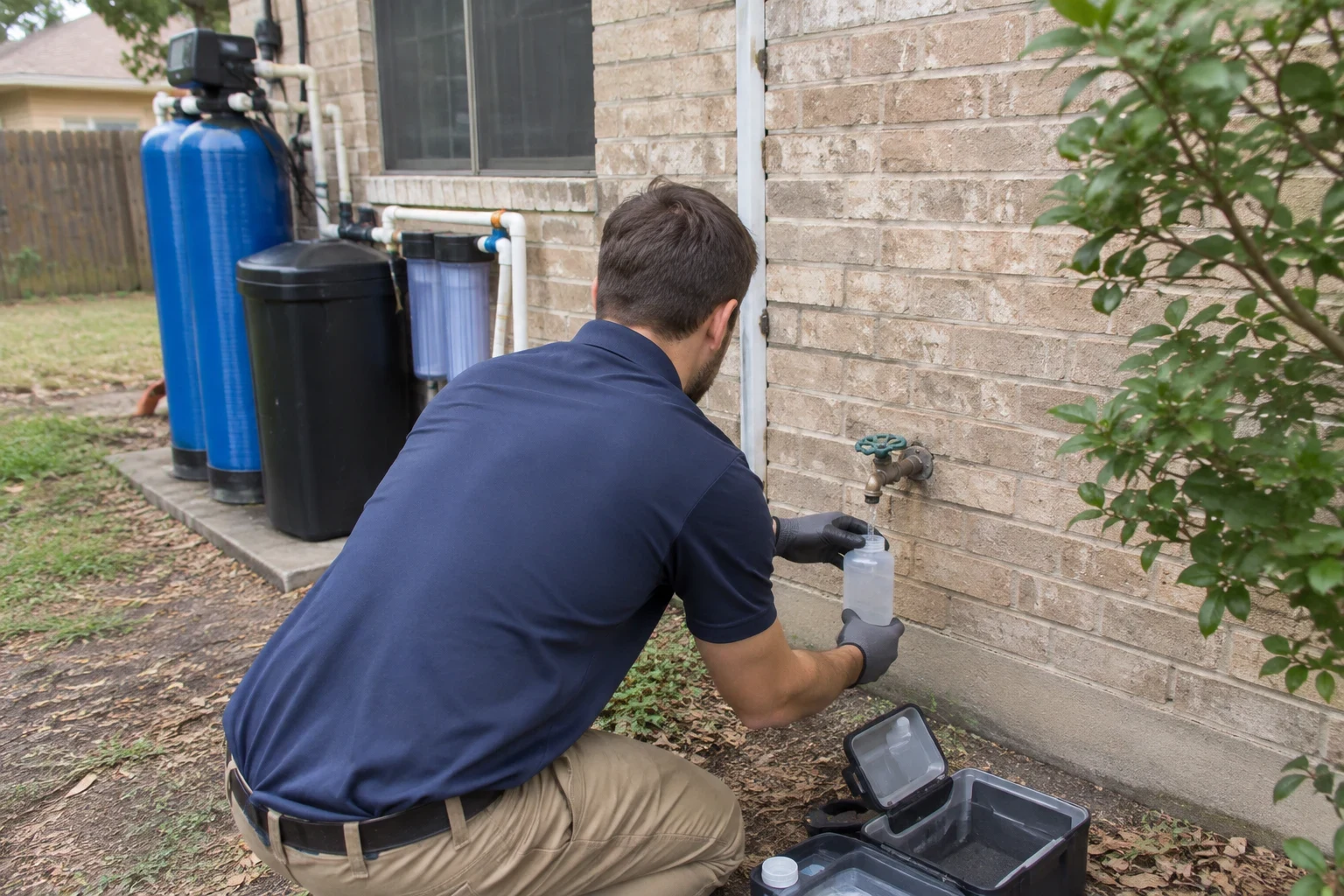
We measure hardness, chlorine and total dissolved solids at your tap. That tells us what the system needs to handle and how hard the prefilters will work.
- 2
We size the system to your water and cabinet
We measure the space in your sink cabinet, check the cold water feed and drain, and match the system to your readings and how much water your household drinks and cooks with.
- 3
Choose tank or tankless
We explain the difference between the tankless RO and the 5-stage tank RO, tell you which one your test and cabinet support, and quote the new system with free installation.
- 4
Install and flush
We mount the system, drill the faucet hole if needed, connect the drain saddle and feed valve, then flush the new filters and membrane before you drink from it. We finish by showing you the TDS reading and the filter change schedule.
What Moves the Price
The price depends on the new system you choose and on your kitchen. The 5-stage tank RO costs less up front, and the tankless RO costs more but needs no storage tank. You get your quote by phone or at the visit, before any work starts.
- Tank or tankless system
- The 5-stage tank RO is the lower-price option. The tankless RO, with 7 stages and 800 gallons per day, costs more up front.
- Stages and add-ons
- A remineralization stage, a permeate pump for low water pressure or a UV lamp each add parts and labor.
- Your countertop
- Drilling a faucet hole in granite or quartz takes a diamond bit and more time than using an existing sprayer hole.
- Hard water ahead of the membrane
- Very hard water scales a membrane faster. In some homes, pairing RO with a water softener or salt-free water conditioner lowers long-term membrane costs.
Reverse Osmosis Questions
- Does an RO unit waste water?
- Some, yes. The membrane keeps itself clean by flushing a reject stream to the drain, and older units can lose several gallons for each gallon of drinking water they make. High-efficiency membranes and a permeate pump shrink that ratio a lot. A working shutoff valve also stops all flow once the tank is full.
- How often do filters and membranes need changing?
- Sediment and carbon filters usually need changing every 6 to 12 months. A membrane often lasts 2 to 5 years, depending on hardness and how much water you use. We go by TDS readings rather than the calendar alone.
- Does RO remove the minerals from my water?
- Yes, it removes most dissolved calcium and magnesium along with everything else. Some people prefer the taste with minerals added back, which a remineralization stage does after the tank.
- Which RO system should I choose?
- The tankless RO makes 800 gallons per day through 7 stages and frees up cabinet space because there is no tank. The 5-stage tank RO costs less and stores filtered water in a small pressure tank. Your test results, cabinet space and budget point to the right one, and we explain why.
- Do I need RO if I already have whole-home filtration?
- They do different jobs. Whole-home carbon handles chlorine taste and odor at every tap, while RO removes dissolved solids and metals at one faucet. Many homes use both, and a water test shows whether you need the second one.
Find Out Which RO System Fits Your Water
We will test your water at no charge and recommend the new RO system that fits your water and your sink cabinet. You will know why before you commit, and installation is free.